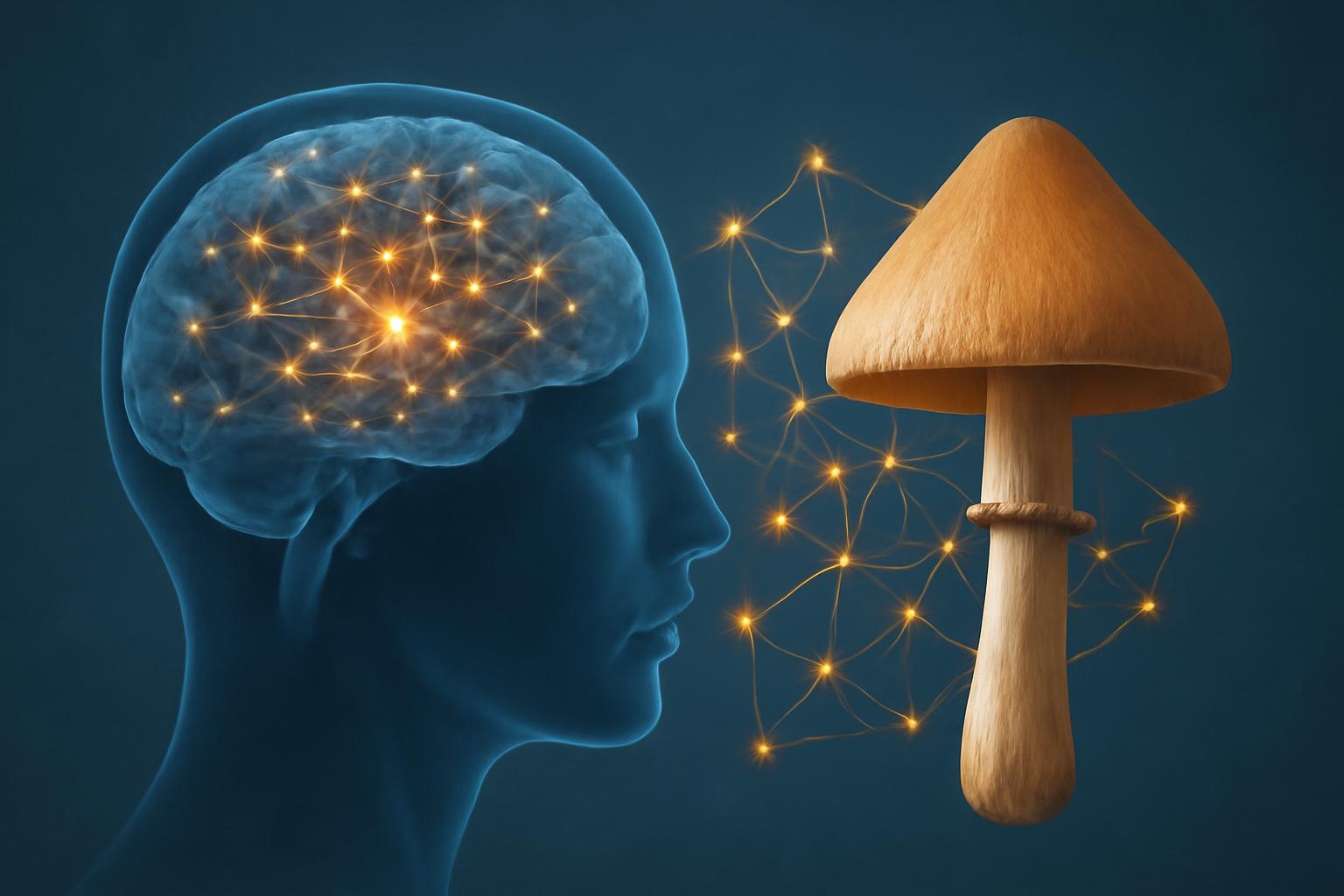
Psilocybin brain connections research is helping scientists examine how psychedelic compounds may influence neurons, synapses, and communication between brain regions. While public discussion often focuses on subjective experiences, laboratory studies are looking more closely at the cellular events that may occur before, during, and after psilocybin exposure.
This field is still developing. Findings from cell cultures, animal models, brain imaging, and human trials do not all answer the same questions. A result observed in a controlled laboratory model cannot automatically be treated as proof of a clinical benefit in people. For that reason, careful study design, verified materials, accurate documentation, and responsible interpretation are central to modern psychedelic mushroom research.
What Psilocybin Brain Connections Research Examines
Psilocybin is a naturally occurring compound found in certain fungi. In the body, it is converted into psilocin, a compound that interacts with several serotonin receptors. Researchers are particularly interested in activity involving the serotonin 2A receptor, which is found in many areas of the brain associated with perception, learning, mood, and cognition.
The phrase “brain connections” can describe several different biological processes. Scientists may use it to discuss the strength of communication between neurons, the formation of new dendritic branches, changes in synaptic signaling, or shifts in communication between larger brain networks. These are related concepts, but they are not interchangeable.
A study may therefore focus on one of several questions:
- Does psilocybin alter signaling between existing neurons?
- Can it influence the growth or structure of dendrites?
- Does it change the flexibility of synapses involved in learning?
- Are changes temporary, or do they persist after the compound leaves the body?
- How do cellular findings relate to behavior or mental health outcomes?
These questions help explain why psychedelic fungi research includes neuroscience, pharmacology, molecular biology, psychology, and analytical chemistry.
How Neurons Communicate
Neurons communicate through electrical signals and chemical messengers. At the junction between two neurons, known as a synapse, one cell releases neurotransmitters that influence the next cell. The receiving neuron may become more or less likely to generate its own signal depending on the receptors activated and the surrounding chemical environment.
Synapses are not fixed structures. They can become stronger or weaker in response to experience, stress, learning, sleep, medication, and other factors. This ability to adapt is commonly described as neuroplasticity.
Researchers studying psilocybin are interested in whether its receptor activity can temporarily alter the conditions that support plasticity. This does not mean that the compound simply “rewires the brain” in a broad or automatic way. Instead, scientists are investigating whether it may influence specific molecular pathways that affect how neurons respond to signals and environmental input.
Cellular Pathways Under Investigation
Serotonin receptor signaling
The first stage of interest is receptor activation. Psilocin interacts with serotonin receptors on nerve cells, including receptors linked to intracellular signaling cascades. These cascades are chains of molecular events inside a cell. They can affect gene expression, protein production, and the way a neuron responds to incoming information.
Because receptor distribution differs across brain regions and cell types, the effects may not be uniform. A pathway activated in one population of neurons may produce a different result in another. This is one reason researchers study cellular specificity rather than treating the brain as a single undifferentiated organ.
Growth-related signaling
Some preclinical studies have explored pathways associated with the growth and maintenance of neuronal structures. These include signaling systems involved in protein synthesis, cytoskeletal organization, and the development of dendritic spines. Dendritic spines are small structures that receive many incoming signals from other neurons.
An increase in spine formation or density can be interesting to scientists, but it should not be interpreted as proof that a person will experience better memory, mood, or decision-making. Structural changes are only one part of a much larger biological picture. Researchers must also determine whether the new connections are functional, stable, appropriately regulated, and relevant to behavior.
Gene expression and protein production
Another area of psychedelic mushroom scientific research involves changes in gene expression. A compound can influence which genes are more or less active without changing the underlying DNA sequence. These changes may affect the production of proteins involved in synaptic signaling, inflammation, energy use, or cellular repair.
Laboratories may measure these effects using techniques such as RNA analysis, protein assays, microscopy, or targeted molecular testing. Reliable results depend on appropriate controls, validated methods, sample preservation, and complete research documentation.
Why Cellular Findings Matter for Mental Health Research
Many psychiatric conditions involve complex patterns of brain activity, behavior, environment, and personal history. Researchers are exploring whether changes in neural flexibility could help explain why some psychedelic-assisted treatment models are being investigated for conditions such as depression, trauma-related disorders, and substance use disorders.
The proposed idea is not that psilocybin alone produces a predictable therapeutic outcome. Instead, researchers often consider the compound, psychological support, physical setting, preparation, and follow-up to be parts of a broader intervention. Cellular changes may be one piece of the explanation, while learning, emotional processing, and changes in behavior may contribute additional pieces.
Human clinical research is especially important because laboratory models cannot fully reproduce human experience. Animal and cell studies can help identify mechanisms and safety questions, but they cannot independently establish how a treatment should be used in people.
Animal, Cell, and Human Studies Answer Different Questions
A cell-culture experiment can isolate a receptor or pathway under controlled conditions. This makes it useful for studying molecular mechanisms. However, cultured cells do not contain the full network of brain regions, immune signals, hormones, and behavioral factors present in a living organism.
Animal studies provide more biological context. Researchers can examine changes in behavior, brain structure, and tissue chemistry. Even so, animal findings must be interpreted carefully because species differ in brain organization, metabolism, and behavior.
Human studies can examine subjective effects, cognitive performance, brain imaging, and clinical outcomes. They also involve additional challenges, including expectations, participant selection, blinding, dose control, psychological support, and long-term follow-up.
Comparing these study types requires precise language. A cellular finding may suggest a mechanism. An animal result may provide preclinical support. A controlled human trial may offer evidence about effects in a defined population. None of these categories should be presented as interchangeable.
Why Research Materials and Documentation Matter
Reliable psychedelic mushroom research depends on more than an interesting hypothesis. Investigators need to know what material was studied, how it was prepared, how it was stored, and whether its identity and composition were confirmed.
For laboratories working with fungal samples, documentation may include:
- Scientific identification and specimen records
- Collection or preparation details
- Storage conditions and handling history
- Batch or sample identifiers
- Analytical results and instrument information
- Controls, calibration records, and deviations
- Chain-of-custody information where appropriate
These practices are relevant to a mushroom research laboratory supplier, a university laboratory, a contract testing facility, or a pharmaceutical research group. They make it easier to reproduce findings and identify possible sources of variation.
Researchers and readers looking for additional site updates can browse the Psychedelic Shrooms Delivery blog homepage. The site’s post sitemap can also help locate newly published research-focused articles, while the category sitemap provides another way to review available topics.
Important Limits of Current Evidence
Research headlines can make early findings sound more conclusive than they are. Several limitations deserve attention when evaluating claims about psilocybin and brain connections.
Short follow-up periods
Some experiments measure effects shortly after exposure. These findings may not reveal whether changes continue for weeks or months. Long-term research is more difficult and requires careful participant monitoring.
Differences between compounds and preparations
Psilocybin-containing fungi can vary in species, strain, growing conditions, maturity, storage, and chemical composition. A purified research compound and an uncharacterized fungal sample are not equivalent materials. Studies must clearly describe what was used.
Variation between individuals
People differ in genetics, medication use, health history, previous experience, expectations, and mental health status. These factors can influence both biological responses and reported outcomes.
Correlation is not causation
If an imaging study observes changed connectivity after a session, that does not automatically prove the connectivity change caused an improvement in symptoms. Researchers need appropriate comparison groups and additional evidence to assess cause and effect.
What Future Psychedelic Fungi Research May Explore
Future studies may examine how receptor activity, gene expression, immune signaling, and synaptic structure interact over time. Researchers may also compare different dosing schedules, therapeutic settings, and follow-up approaches.
Improved imaging and molecular tools could help scientists connect cellular events with changes in larger brain networks. More consistent sample characterization may also make it easier to compare findings across laboratories. In addition, species identification services, mushroom chemistry research, and validated laboratory analysis may help clarify how different fungal materials vary.
Another important direction is the study of safety. Understanding possible benefits requires equal attention to adverse psychological reactions, medication interactions, cardiovascular effects, impaired judgment, and risks for people with certain psychiatric or medical conditions. Responsible research does not separate possible benefits from potential harms.
Legal and Safety Considerations
Psilocybin and psilocybin-containing mushrooms are controlled or restricted in many parts of the United States, although laws vary by state and locality. Research access may require institutional approvals, specialized facilities, permits, and compliance with applicable federal and state regulations.
This article is for educational purposes only. It is not medical advice, legal advice, or an invitation to purchase, possess, cultivate, or use controlled substances. Anyone considering a psychedelic-related study should work through a qualified institution and follow all applicable rules, ethics requirements, and laboratory safety procedures.
Frequently Asked Questions
Does psilocybin permanently rewire the brain?
Current research does not support a simple universal answer. Some preclinical studies have reported changes associated with neural plasticity, but the duration, meaning, and clinical relevance of those changes remain under investigation. “Rewiring” is often used as a simplified media phrase rather than a precise scientific conclusion.
Are increased neural connections always beneficial?
No. More connections are not automatically better. Healthy brain function depends on appropriate signaling, timing, regulation, and integration. Researchers must determine whether observed structural changes are functional and beneficial, neutral, or potentially disruptive.
Can mushroom samples be used interchangeably in research?
No. Fungal samples can differ in species identity, chemical profile, storage history, and contamination risk. Research teams should use verified materials and maintain clear documentation so that results can be interpreted accurately.
What is the role of a psilocybin research supplier?
A legitimate research supplier may provide documented materials or reference products to qualified laboratories under applicable regulations. Researchers should evaluate identity records, analytical documentation, storage controls, and compliance procedures before accepting any material.
Does laboratory research prove that psilocybin treats depression or PTSD?
No. Laboratory and clinical studies may provide evidence about mechanisms, safety, or potential effectiveness, but they do not establish that psilocybin is appropriate for every person. Treatment decisions should be made with qualified medical professionals where legal and clinically available.
The Bottom Line
Psilocybin brain connections research is moving beyond broad claims about “rewiring” and toward more detailed questions about receptors, synapses, gene expression, and cellular signaling. The most useful studies connect these biological observations with carefully measured behavioral and clinical outcomes.
As the field develops, accurate sample identification, transparent methods, reproducible laboratory work, and cautious interpretation will remain essential. A stronger understanding of psychedelic fungi will come not from headlines alone, but from research that clearly explains what was studied, how it was measured, and what the evidence can—and cannot—show.